Louisiana Gov. Jeff Landry plans to push back his state’s May 16 primary to give state lawmakers time to redraw congressional maps there, after the Supreme Court struck down the current district lines in a decision with far-reaching consequences for control of Congress in 2026 and beyond.
Subscribe to read this story ad-free
Get unlimited access to ad-free articles and exclusive content.

Landry, a Republican, called congressional Republicans to inform them of the plan, a source familiar with the conversations told NBC News. A second source, a Louisiana-based GOP strategist, also confirmed Landry’s plans to NBC News.
In a joint statement issued Thursday morning, Landry and state Attorney General Liz Murrill said the Supreme Court’s decision meant the state couldn’t move forward with its current maps. “We are working together with the Legislature and the Secretary of State's office to develop a path forward,” they said.
The Washington Post first reported Landry’s decision.
Absentee voting for the May 16 primary is already underway in Louisiana, and early voting is set to start this weekend. It’s likely any move to halt voting could face legal scrutiny. But Republicans are confident they’ll be able to press pause on the process because the Supreme Court’s Wednesday ruling directly labeled Louisiana’s congressional lines an unconstitutional racial gerrymander.
In response, Republican lawmakers are set to draw lines eliminating at least one of the state's two Democratic-held districts, starting with the one currently held by Rep. Cleo Fields, whose district is at the center of the court challenge. The only other Democrat in the delegation is Rep. Troy Carter, who represents much of New Orleans and communities to its west.
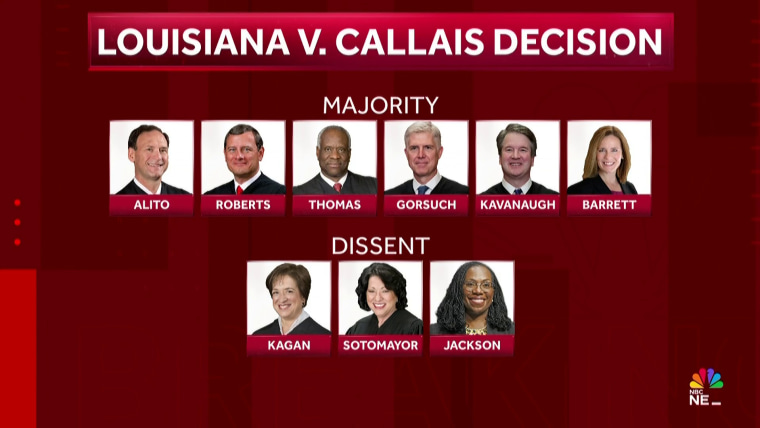
Louisiana’s move is just the beginning of the fallout from the Supreme Court’s ruling, which severely limited provisions of the Voting Rights Act which had been used to guarantee the creation of majority-minority districts in states with significant populations of voters of color, allowing those voters to elect candidates of their choice.
While the law had previously been construed to allow for the consideration of voters’ race while drawing districts, Justice Samuel Alito wrote in his majority opinion that “allowing race to play any part in government decision-making represents a departure from the constitutional rule that applies in almost any other context.â€
In the short term, that ruling could allow a handful of Republican-controlled states to redraw lines to give their party a boost in the battle for control of Congress. But the full political impact of the decision likely won't be felt until 2028, when states have a full election cycle to take action. Democrats warn that could dramatically reduce, or possibly eliminate, seats currently held by Black Democrats in the South.
It’s still unclear whether or how the move would affect Louisiana’s heated Senate primary, where Republican Sen. Bill Cassidy is fighting for his political career against a crowded field that includes Rep. Julia Letlow, who has President Donald Trump’s endorsement.
House Speaker Mike Johnson told reporters Friday that “the governor has no choice but to suspend [the May 16 primary] because the courts just ruled our map unconstitutional.â€