Key TG Jones landlords back restructuring plan, though some creditors oppose it

Sarah Butler
The owner of WH Smith's former high street business – TG Jones – will next week seek court approval for a stringent restructuring plan involving the closure of up to 150 stores after major landlords, the Post Office and some suppliers backed the plan.
More than 80% of landlords controlling TG Jones' top stores voted to support the deal this week, according to documents seen by The Guardian with the majority other classes of landlords, who will face swingeing rental cuts under the plan, voting against it.
Several different classes of creditor voted over two days this week on the restructure but the plan requires approval – judged as backing from 75% or more – from just one class of creditor and from a high court judge to go ahead.
Only 72% of business rates creditors – mostly local councils – backed the plan and less than a third of general creditors, who include card makers, pen brands, gave it the thumbs up. No landlords owning unwanted stores where rent will be cut to zero or closed backed the plan.
Small suppliers are to lose at least half the money owed to them by the former WH Smith high street chain if a High Court judge approves the restructure next week. There will be two hearings related to the two companies which make up TG Jones which are being restructured – one on Monday and one on Tuesday.
The books to paperclips retailer, which has 450 stores, was bought by the private equity firm Modella Capital last year and rebranded TG Jones.
The company has said it is likely that it will have to call in administrators if its restructuring plan is not approved.
Dozens of “exit contract†suppliers, which TG Jones does not wish to work with in future, including toy makers and greetings card companies, are expected to have debts owed to them by the retailer wiped out if the proposal is approved.
They would retain the right to a share of any profits over a certain level from the retailer – which is now loss-making – in three years' time.
Key events
Closing post
And finally, the UK's FTSE 100 index has ended the day slightly lower.
The index of blue-chip shares finished the day down 0.21% at 10,508 points, slightly below last night's two-month closing high.
Precious metals miner Endeavour (+2.9%) finished as the top riser, while specialist chemicals maker Croda (-4.9%) was the leading faller.
That's all for this week – here's today's main stories.
Oil lower than at start of Iran war
The oil price has hit a fresh four-month low, as it drops below its level before the start of the Iran war.
Brent crude has fallen around 5% to as low as $71.52 a barrel, the lowest since 27 February – the day before the conflict began.
Some economists are suggesting that the reopening of the strait of Hormuz could lead to a supply glut (even though many governments need to restock their emergency reserves).
Capital Economics say:
double quotation mark Traffic through the Strait of Hormuz is picking up but, so far, there are more vessels leaving the Gulf than entering it. Alongside possible technical issues with restarting energy facilities, the recovery in hydrocarbon output over the rest of this year is likely to be bumpy.Further ahead, energy production in the Gulf looks set to be ramped up, which will lift GDP but result in a return to glut-like conditions global energy markets.
Oil prices will fall further in 2027-28, limiting the scope for the likes of Saudi Arabia and Bahrain to provide fiscal support to support the recoveries in their non-oil economies.
After some pessimistic months, US consumer confidence has picked up in June.
The University of Michigan's index of consumer sentiment has risen to 49.5 this month, up from May's 44.8, as easing gasoline prices cheered Americans.
Surveys of Consumers director Joanne Hsu explains:
double quotation mark Consumer sentiment confirmed its early-month reading, rising about 10% above May as gas prices moderated.Increases were seen across income, wealth, and political affiliation. Expected business conditions over the next five years surged 16% as consumers' worries over long-term consequences of the Iran conflict appear to be easing.
Still, sentiment remains in unfavorable territory at 13% below the February 2026 reading prior to the start of the Iran conflict, and nearly 20% less than a year ago. The cost of living remains at the forefront of consumers' minds; for the third straight month, over half of consumers spontaneously mentioned that high prices are weighing down their personal finances.
Back in the Middle East, a total of about 115 vessels and 2,500 seafarers have been evacuated from the Strait of Hormuz since Tuesday, the head of the UN maritime body has said.
International Maritime Organization secretary-general Arsenio Dominguez gave the update after the IMO on Thursday suspended its efforts to evacuate some 600 ships and 11,000 sailors, following an attack on a vessel in the Gulf of Oman.
Dominguez told an online press conference that “115 (vessels) have evacuated in the last three and a half days, representing around 2,500 seafarers that have now safely left the Strait of Hormuzâ€, the AFP newswire reports.
Key TG Jones landlords back restructuring plan, though some creditors oppose it
Sarah Butler
The owner of WH Smith's former high street business – TG Jones – will next week seek court approval for a stringent restructuring plan involving the closure of up to 150 stores after major landlords, the Post Office and some suppliers backed the plan.
More than 80% of landlords controlling TG Jones' top stores voted to support the deal this week, according to documents seen by The Guardian with the majority other classes of landlords, who will face swingeing rental cuts under the plan, voting against it.
Several different classes of creditor voted over two days this week on the restructure but the plan requires approval – judged as backing from 75% or more – from just one class of creditor and from a high court judge to go ahead.
Only 72% of business rates creditors – mostly local councils – backed the plan and less than a third of general creditors, who include card makers, pen brands, gave it the thumbs up. No landlords owning unwanted stores where rent will be cut to zero or closed backed the plan.
Small suppliers are to lose at least half the money owed to them by the former WH Smith high street chain if a High Court judge approves the restructure next week. There will be two hearings related to the two companies which make up TG Jones which are being restructured – one on Monday and one on Tuesday.
The books to paperclips retailer, which has 450 stores, was bought by the private equity firm Modella Capital last year and rebranded TG Jones.
The company has said it is likely that it will have to call in administrators if its restructuring plan is not approved.
Dozens of “exit contract†suppliers, which TG Jones does not wish to work with in future, including toy makers and greetings card companies, are expected to have debts owed to them by the retailer wiped out if the proposal is approved.
They would retain the right to a share of any profits over a certain level from the retailer – which is now loss-making – in three years' time.
The UK public are less anxious about inflation, following the easing of tensions in the Middle East.
Expectations for inflation in a year's time have dropped to 3.8% from 4.7%, nearer to the Bank of England's 2% target (although still rather higher!).
Inflation expectations in five or more years' time have fallen to 3.9% this month from 4.0% in May, new data from US bank Citi and pollsters YouGov shows.
The chip firm sell-off has resumed on Wall Street, as trading begins for the final day this week.
Wall Street's main indexes have all dropped at the start of trading; the Dow Jones Industrial Average fell 116.9 points, or 0.23%, to 51803.77, while the broader S&P 500 lost 0.6% and the tech-focused Nasdaq is down 1%.
ON Semiconductor Corp (-20%) is leading the slide, with Sandisk down 8.6%, and Nvidia losing 1.8%.
US trade in goods deficit hits one-year high
Oof! America's trade deficit with the rest of the world has ballooned, in a sign that Donald Trump's trade war is not bearing fruit.
The US trade in goods deficit jumped by $22.7bn in May to $105.8bn, new data from the Census Bureau shows, up from $83.0bn.
That's the highest monthly goods trade deficit since March 2025, when there was a scramble to import stuff before Donald Trump's Liberation Day tariffs were announced.
The data shows that US goods exports fell by $11.8bn in May, to $207.7bn, including a fall in exports of ‘foods, feeds, & beverages' and automobiles.
Imports jumped by $10.9bn to $313.4bn in the month, led by higher shipments of capital goods – which could include equipment to build America's AI data-centre rollout.
Britain's smaller share index, the FTSE 250, is also dropping today.
The FTSE 250, which contains medium-sized companies, is down just over 1%. AEP Plantations (-6.5%), which produces palm oil and rubber, are the top faller, followed by advertising group WPP (-5.4%).
Bars and pubs busy in the heatwave
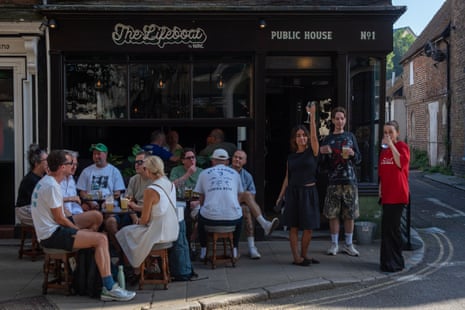
UK pubs and bars are enjoying a roaring trade in the heatwave, according to data from global payments platform Square.
Square reports that there was a jump in transactions on Monday, Tuesday and Wednesday, compared with a year ago. However, restaurants in London experienced a drop in trade, as some workers decided to stay at home rather than brave the commute.
Tuesday, when the England men's football team struggled against Ghana's low block, was particularly busy in the pubs.
Square reports:
-
Bars and pubs saw transactions up 11.7%, the strongest signal across any hospitality category
-
Restaurants were roughly flat (+1.0%)
-
London showed a different pattern, as bars and pubs were up just 2.0%, while restaurants were down -4.7%
-
Tuesday 23 June was the peak day nationally for bars, pubs and restaurants
John O'Beirne, CEO of Square International, says:
double quotation mark “Across the country, Brits gravitated towards bars and pubs to cool down as temperatures spiked this week. This is in contrast to what we saw in London, where there was a spend shift away from the centre, suggesting people have been seeking out suburban venues and more outdoor spaces to escape the heat of the capital.â€
XTB: The hand to mouth tech rally has halted
Today's losses show that the tech stock rally is losing momentum, points out Kathleen Brooks, research director at XTB:
double quotation mark A rotation is going on in US stocks right now, the weakest performing companies on the S&P 500 include those most closely linked to AI, including Palantir and Oracle, which are down 18% and 16% respectively this week. There are also chunky losses for some of the Magnificent 7, including Microsoft, Alphabet, Apple and Nvidia. The move away from tech heavy AI names is allowing value stocks to shine. The top performing sectors in the US this week include industrials, real estate, consumer discretionary, energy and healthcare, which is the top performing sector and is higher by more than 4%.The hand to mouth tech rally has come to an abrupt halt at the end of the week. After Thursday's recovery rally on the back of Micron results, which caused the stock price to soar by 15%, a dearth of good news is weighing on the sector and the entire AI narrative. Micron's stock price is down 4% in the pre-market, other memory chip stocks are also sinking, and SanDisk is down 5%. Nvidia is also lower by 1%, which could drag US stock indices lower if Nvidia's losses persist as we move through Friday.